Tolerance Stack Up Analysis
A tutorial + an AI capability test

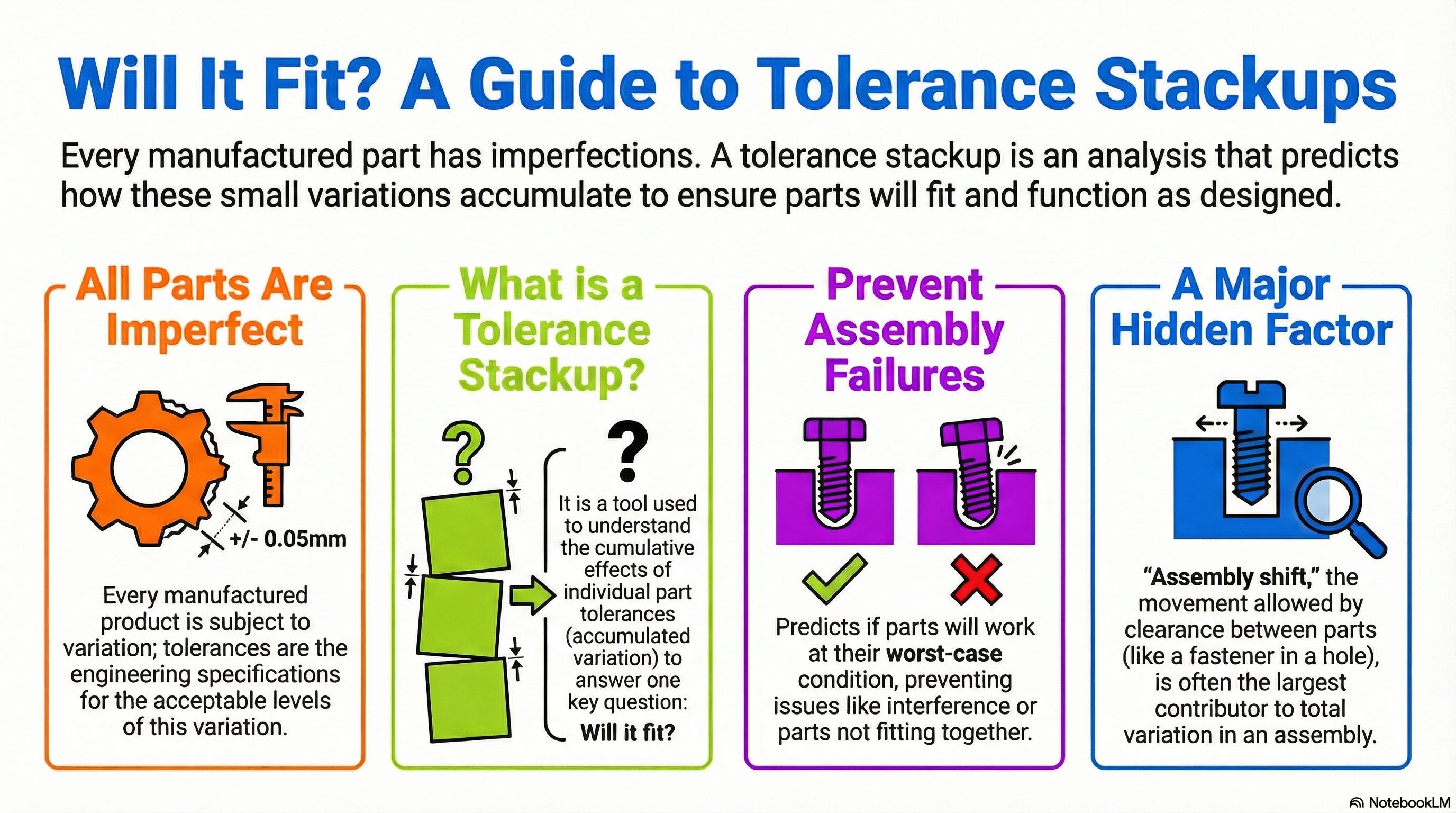
Why does tolerance matter? Because in the real world, nothing is perfect, and understanding the acceptable boundaries of variation is the critical difference between a robust product and catastrophic failure. A fundamental truth of design and manufacturing is that: no part is perfectly formed. Every single feature is subject to inherent variation.
In short, tolerance is the acceptable range of variation allowed in a dimension or performance characteristic. It represents the “wiggle room” or “play in the system” that must be accounted for. A tolerance is the specified amount a feature is allowed to vary from its nominal (or perfect) dimension.
Why Tolerance Matters
Why are these limits so critical? Tolerances are the sole method designers have to establish the functionally allowable dimensional limits for each feature. They are essential for ensuring functionality, fit, assembly, and quality control.
1. Ensuring Quality and Assembly: Tolerances ensure that parts meet specifications and will actually fit together when assembled, even if they are imperfect. This is paramount in modern manufacturing philosophies like mass production, where the interchangeability of blindly selected parts is essential.
2. Preventing Failure or High Cost: Lack of attention to tolerance specification can make a part nonfunctional or, conversely, setting specifications too tightly can drive up manufacturing costs drastically.
3. Clarity and Communication: Tolerances clearly and unambiguously communicate design requirements. If tolerances are not explicitly specified, manufacturers and inspectors are forced to guess the limits of acceptability, which leads to costly waste of time or the risk of accepting a bad part.
When multiple components—each carrying its own inherent variation—are brought together, their individual tolerances accumulate. This accumulation is the tolerance stack-up, and it dictates the final clearance, interference, or distance between features in the finished product.
In this post, you will learn by solving a given design problem, the step-by-step guide required to analyze a cumulative variation, ensuring your designs will satisfy their intended function.
Worst-Case Tolerance Analysis
Worst-case tolerance analysis finds the maximum possible variation of a particular gap or distance. That distance is usually not a controlled dimension (it may appear as a reference), so its limits aren’t predefined—otherwise no analysis would be needed.
To compute a worst-case tolerance stackup you algebraically add and subtract the contributing dimensions, tolerances, and other variables to produce the total possible variation of the studied distance. This method assumes each contributing dimension can simultaneously be at its extreme (maximum or minimum), even though that combination might be unlikely.
A tolerance stackup is arranged as a chain of dimensions and tolerances: the individual dimensions link end-to-end from one point (A) to the other (B), just like the links of a chain.
Problem Specification
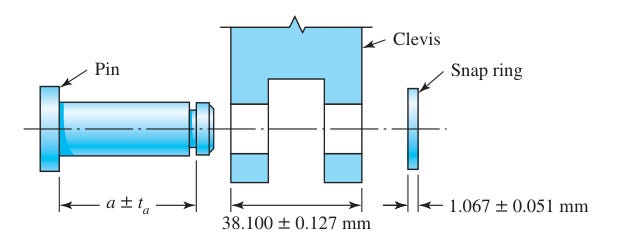
A pivot in a linkage has a pin in the figure whose dimension a ± ta is to be established. The thickness of the link clevis is 38.100 0.127 mm. The designer has concluded that a gap of between 0.102 and 1.270 mm will satisfactorily sustain the function of the linkage pivot. Determine the dimension a and its tolerance.
Step-by-Step Procedure
Select the target distance.
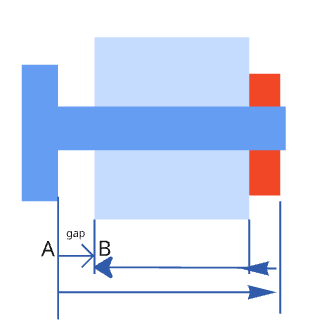
Identify the critical distance (gap or interference) whose variation is to be controlled - in this case it is the gap in the assembled state. Label one end as Point A and the other as Point B (see Figure 2).
Determine the dimensional complexity of the analysis.
a. If a two-dimensional analysis is needed, first check whether both directions can be reduced to a single linear direction using trigonometry. If they cannot, a linear tolerance stackup is not suitable, and a computer-based tolerance analysis should be used instead.
b. If a three-dimensional analysis is required, a linear tolerance stackup is generally not appropriate. A computer program is needed for the analysis.Establish the positive and negative directions.
a. The positive direction is defined as the direction from Point A to Point B. Once A and B are labeled, the direction from A toward B is positive.
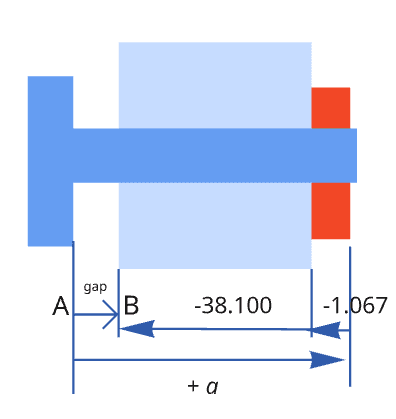
b. Build the chain of dimensions and tolerances. Start at Point A and trace each dimension toward Point B. If a dimension extends toward B, label it positive (“+”) using the origin symbol and arrowhead as described above. If a dimension extends away from B, label it negative (“–”). Continue this process until all dimensions between A and B are labeled as part of the chain of dimensions and tolerances. See Figure 3.
c. Verify the chain continuity.
Follow the entire sequence from Point A to Point B, ensuring each dimension begins where the previous one ends. For example:
The first dimension starts at A and ends at the left edge of the part.
The second dimension starts at that edge and ends at the right edge.
The third dimension begins where the second ends, and so on, until the final dimension ends at Point B.
Make sure all tolerances are given in equal-bilateral format.
if not, convert those to equal bilateral format. In this case all tolerances are already given in equal-bilateral format, e.g. ±0.127 for the Clevis.For the gap, since a range 0.102 and 1.270 mm is given, we should convert this range into equal-bilateral format:

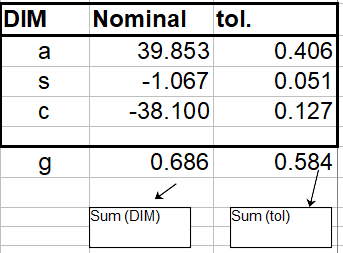
so, the gap can be expressed as g = 0.686 ± 0.584.
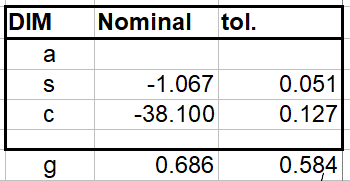
Enter all dimensions and tolerances into a table
List each dimension on a separate line with their sign and values. In the tolerance column, record the tolerance associated with each dimension. Each tolerance value should represent half of the total allowed variation for that dimension.
Sum the columns.
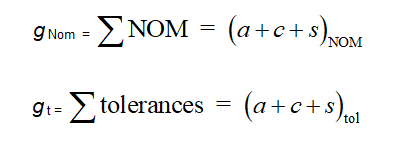
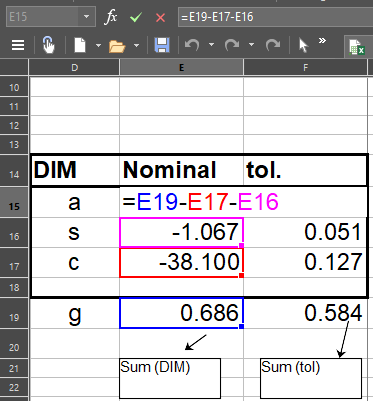
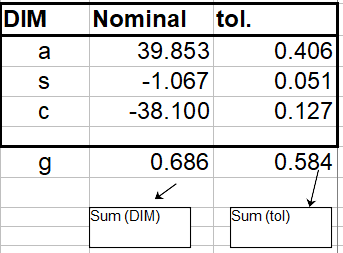
Adding all entries in each column gives the total at the bottom of the table, which represent the nominal and tolerance values for the target dimension, g in this example.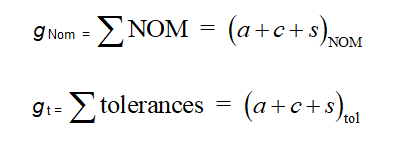
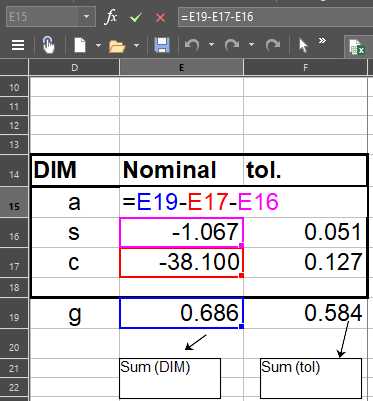
Since g is given in this example, from above equations we can finally calculate for the pin length a nominal and tolerance values:

We tested whether AI can solve this simple tolerance stack-up challenge. ChatGPT arrived at the correct answer after two rounds of clarification and correction. Gemini arrived at the correct answer after one iteration. Watch on YouTube.